







Smart TVs for Gaming in 2025: OLED vs QLED vs Mini-LED

Are you planning on getting a smart TV for gaming in 2025? These are the things that you should look for before investing in a TV.
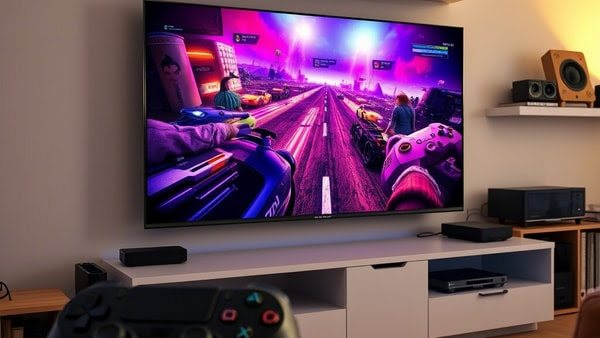
Gaming on a smart TV in 2025 isn’t just about plugging in your console and hitting play. Picture quality now plays a defining role in how immersive, responsive, and competitive your experience feels, especially with next-gen titles pushing the limits of hardware. If you're serious about upgrading your setup, here's what you need to know beyond just screen size and resolution.
Picture quality technologies explained
OLED, QLED, Mini-LED, and MicroLED dominate the 2025 gaming TV space.
- OLED offers deep blacks and near-instant response times. Great for dark, atmospheric games.
- QLED delivers punchy colours and higher brightness, often at lower prices.
- Mini-LED bridges the gap, combining contrast and clarity with better peak brightness.
- MicroLED, still niche, brings the best of both but at a premium.
Add to that AI upscaling (like Samsung’s Vision AI or LG’s AI Picture Pro) and frame interpolation, and even older titles or 1080p streams look sharper and smoother.
Matching picture quality to game types
Esports and FPS games demand high refresh rates (120Hz or more), ultra-low input lag, and clear motion. OLEDs with 144Hz panels and native low latency modes dominate here. Just steer clear of TVs with aggressive motion smoothing, as it adds lag.
Open-world RPGs like Starfield or Elden Ring shine on OLED and high-end Mini-LED TVs, where deep blacks, nuanced colours, and HDR depth elevate the whole experience. AI upscaling helps too, enhancing fine world textures.
Casual and indie games don’t need bleeding-edge specs. A mid-range QLED or LED with decent HDR and a 60–120Hz refresh rate works fine. These TVs, especially with good AI upscalers, give life to stylized or 2D games without overspending.
For all types, strong HDR performance boosts story-driven titles by adding depth and realism to cutscenes and in-game environments.
Esports suitability: Are smart TVs ready?
Yes, if you pick right. Look for:
- Input lag under 10ms
- HDMI 2.1 ports for 4K at 120Hz
- VRR (Variable Refresh Rate) for smoother performance
Some newer smart TVs also offer cloud gaming integrations, like Samsung’s Gaming Hub or Google TV’s support for Nvidia GeForce Now and Xbox Cloud Gaming. But older or budget models often miss these features, leading to stutters and inconsistent frame pacing.
Technologies to rely on and avoid in 2025
Trust these:
- OLED or Mini-LED for visual clarity and HDR depth
- HDMI 2.1 for current and next-gen console compatibility
- AI picture engines for enhanced upscaling
- Dedicated gaming modes with VRR and ALLM
Avoid these:
- TVs with motion interpolation turned on by default because it kills input responsiveness
- Old LED panels with weak local dimming and slow response times
- Budget TVs hyped with "gaming-ready" labels but lacking HDMI 2.1 or decent refresh rates
Practical buying tips for Indian gamers
Pick based on your platform, a cloud gaming user has different needs than a PS5 player. Match screen size to your space and check brightness levels if you game in well-lit rooms. Prioritize local warranty and service, especially for high-end OLEDs. Don’t fall for branding, as sometimes a ₹60K QLED outperforms a ₹90K budget OLED for the kind of gaming you do.
Source: Mint
Quester
Please sign in
Login and share