



























Discovery of World’s Oldest Lepidosaur Fossil in the UK Redefines Evolution

Scientists have uncovered an astonishing fossil of the oldest known lepidosaur, Agriodontosaurus helsbypetrae, offering fresh insights into the origins of modern lizards, snakes, and the tuatara.

A groundbreaking discovery has stunned paleontologists: a complete fossil of Agriodontosaurus helsbypetrae, an ancient lepidosaur species from the Triassic period. Unearthed in the Helsby Sandstone Formation in Devon, UK, this 242-million-year-old fossil challenges previously held beliefs about the early ancestors of modern reptiles. Published in Nature on September 10, 2025, this fossil forces a reevaluation of what we know about lepidosaur evolution. It marks a significant step in understanding how the first lizards and snakes evolved, revealing a complex picture that does not fit neatly into prior expectations.
A Surprising Find: The Fossil’s Features
The fossilized remains of Agriodontosaurus helsbypetrae were discovered on a beach in Devon back in 2015. However, it wasn’t until recent studies that paleontologists were able to properly examine and understand the significance of the find. The species lived during the Middle Triassic epoch, a critical period just before dinosaurs took over the Earth. Measuring only around 10 cm in body length, this tiny creature was unlike anything scientists had anticipated.
This discovery is pivotal because it reveals the vast diversity in early lepidosaurs, many of which have been poorly represented in the fossil record.
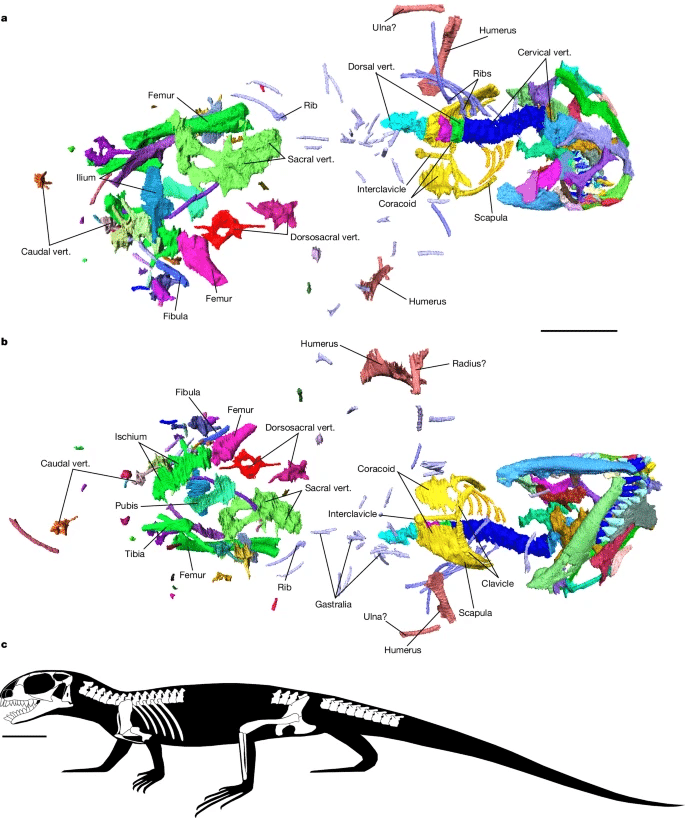
As Dan Marke, a paleontologist at the University of Bristol and the University of Edinburgh, observed, “The new fossil shows almost none of what we expected.” Despite predictions that early lepidosaurs would possess certain characteristics like hinged skulls, palatal teeth, and an open lower temporal bar, Agriodontosaurus helsbypetrae defied these assumptions. “It has no teeth on the palate, and no sign of any hinging,” Marke explained. Instead, this ancient reptile retained only one out of three expected traits—the open temporal bar, which links the skull to the jaw hinge.
What Was Expected vs. What Was Found
“It was always expected that the first lepidosaurs would have had some of the lizard characters such as a partially hinged skull, an open lower temporal bar, and abundant teeth on the roof of the mouth (palate),” said Professor Michael Benton from the University of Bristol. These traits are typically seen in modern lizards and snakes, aiding them in catching and consuming prey. Snakes, for instance, have evolved a remarkable ability to manipulate large prey through a flexible skull and the use of teeth on the palate to grip and swallow animals whole.
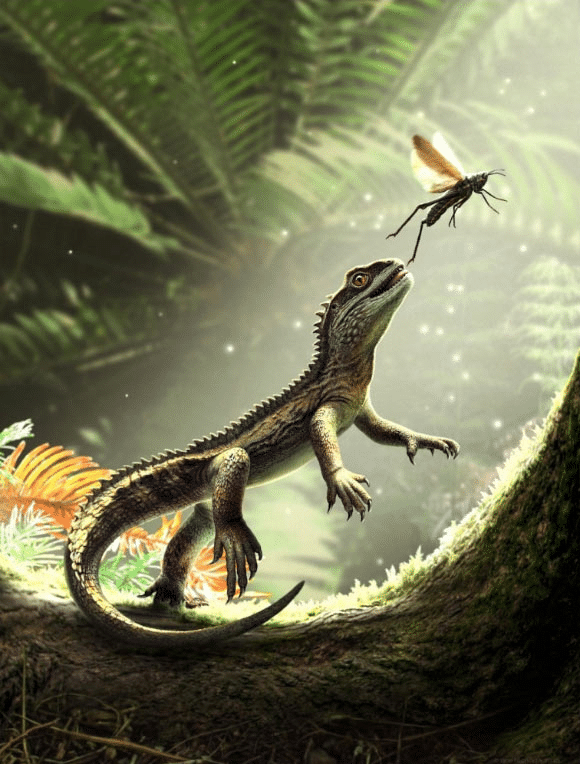
While the fossil did not show the expected palatal teeth or a hinged skull, it did have one defining feature—the open lower temporal bar. This anatomical trait remains an essential component in understanding the evolution of reptiles, especially when comparing it to today’s lizards and the tuatara, a living species that preserves more primitive traits.
The Significance of the Temporal Bar: Key to Understanding Lepidosaur Evolution
One of the most important aspects of the fossil is its temporal bar. The temporal bar is a bony structure running from the cheek to the jaw hinge, which plays a crucial role in the articulation of the skull. “The lower temporal bar is essentially the cheek bone, a bony rod that runs between the cheek and the jaw hinge and is absent in lizards and snakes today,” explained Benton. This structure has been used to differentiate early reptiles from their more modern descendants.
Large Teeth for Shearing: A New Feeding Strategy?
Another remarkable feature of Agriodontosaurus helsbypetrae is its large, triangular-shaped teeth, which were likely adapted for a specialized feeding strategy. Unlike the sharp, pointed teeth of modern reptiles, these teeth were likely used to pierce and shear the hard cuticles of insect prey, much like the tuatara does today. “The new beast has relatively large triangular-shaped teeth and probably used these to pierce and shear the hard cuticles of its insect prey, pretty much as the tuatara does today,” said Professor Benton.
Rethinking Lepidosaur Evolution
The discovery of Agriodontosaurus helsbypetrae challenges current thinking on the origins of lizards, snakes, and the tuatara. As Dan Marke aptly stated, “The new animal is unlike anything yet discovered and has made us all think again about the evolution of the lizard, snakes and the tuatara.” The unique combination of features found in this species—a mix of expected and unexpected traits—will likely reshape the way scientists understand lepidosaur origins. This discovery is a pivotal moment in paleontology, pushing researchers to reconsider evolutionary pathways that were once thought to be straightforward.
Source;IndianDefencereview
Please like and follow

Please sign in
Login and share