










Post-quantum Cryptography

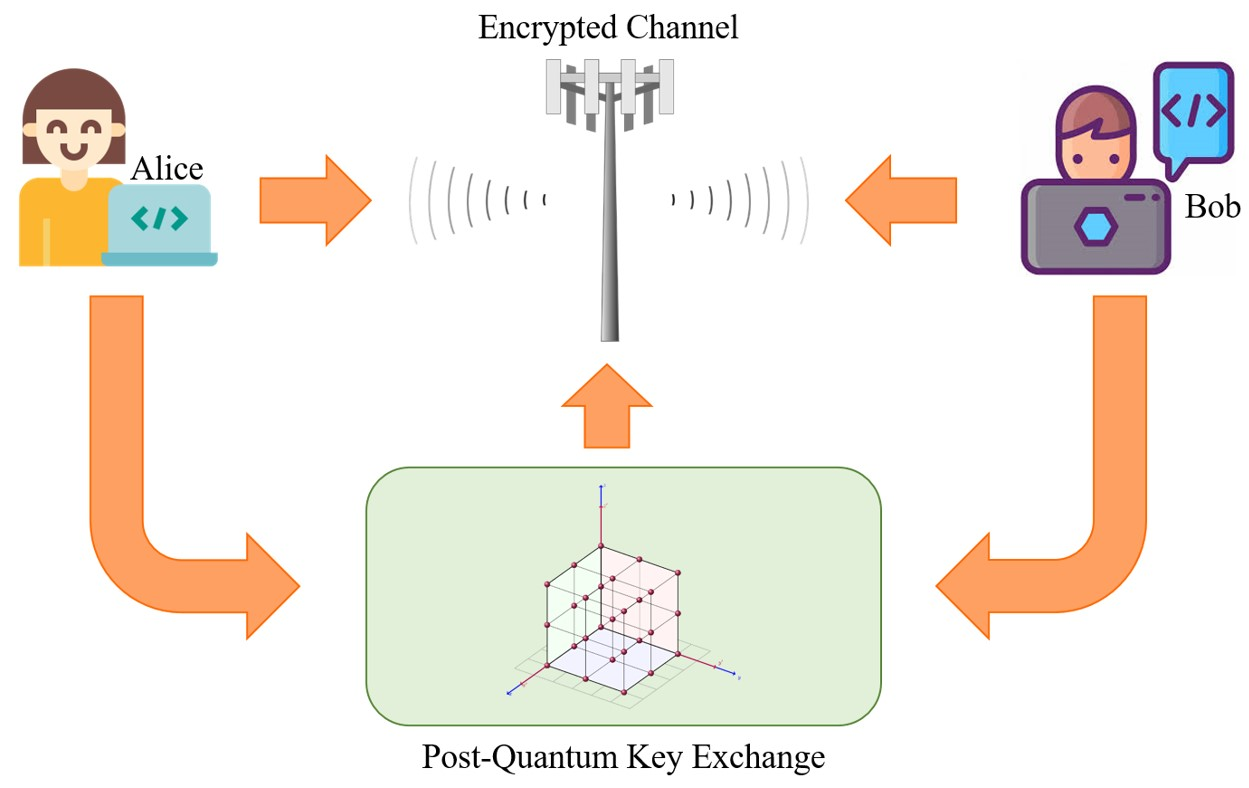
Figure 1, view larger image
Right now, most online security (like banking, WhatsApp messages, digital signatures) relies on algorithms such as RSA or Elliptic Curve Cryptography (ECC).
These systems are strong against normal computers, but a powerful quantum computer could solve their encryption keys in minutes.
👉 So, Post-Quantum Cryptography means creating new encryption methods that even quantum computers cannot crack.
🧠 How It Works
Instead of using traditional number-based keys (like prime factorization), PQC uses complex mathematical structures that are hard for both classical and quantum computers to solve, such as:
- Lattice-based cryptography – uses multidimensional math problems (the hardest to break).
- Hash-based cryptography – relies on one-way hash functions that can’t be reversed.
- Code-based cryptography – built on error-correcting codes that hide data in noise.
- Multivariate polynomial cryptography – based on solving large equations with many unknowns.
🧩 Why It’s Important
- Quantum computers are coming soon, and they could break today’s encryption (making private messages, passwords, and bank data unsafe).
- PQC ensures that all communication, from personal chats to government data, stays secure in a quantum era.
- It’s being adopted early by major tech companies and governments to future-proof data security.
🌍 Real-World Applications
- Banking & Finance: Protecting online transactions and blockchain systems.
- Cloud Security: Making cloud storage quantum-safe.
- Military & Government: Securing confidential communications.
- IoT Devices: Ensuring smart devices remain protected even in a quantum-powered future.
🔮 Future Outlook
- The U.S. National Institute of Standards and Technology (NIST) has already started standardizing quantum-safe algorithms.
- Within the next 5–10 years, most major websites, apps, and digital signatures will shift to post-quantum encryption.
- Tech giants like Google, IBM, and Microsoft are already testing PQC in browsers, VPNs, and data centers.
Thank you
Your Qool Quester
Ayush pandey
Tech
92
5
Please sign in
Login and share
Sign in