



























Digimon Story: Time Stranger Review: A Love Letter to PS2-Era JRPGs..

Digimon Story:
Time Stranger improves on what made Cyber Sleuth great, while fixing that game’s old technical issues and design flaws. Built entirely for modern hardware, this new installment creates a Digital World that feels vibrant and alive, full of detailed environments and over 450 redesigned Digimon.
Combat stays turn-based and rewards smart use of type advantages and weaknesses, though you can use auto-battle for the easier fights. It captures the spirit of classic PS2-era JRPGs-for better and worse-with charming characters and satisfying progression balanced against clunky fast travel, too many menus, and a strangely silent main character.
Time Stranger doesn't reinvent the genre, but it polishes the familiar formula with care and personality. If you don't mind a few old-school quirks, it offers a deeply enjoyable 40–60 hour adventure centered on monster collecting and strategic battles.
A Time Loop Mystery with Gradual Momentum
Time Stranger starts off with a slow, deliberate pace that can feel a bit sluggish. You play as either Dan or Kanan, secret agents from the organization ADAMAS, which investigates strange anomalies. The character you choose stays mostly silent, while the other acts as your mission operator and is fully voiced. After the Shinjuku Inferno disaster sends you eight years into the past, your mission becomes clear: return to the present and stop the catastrophe before it happens.
The first few hours move slowly as you're introduced to Inori Misono and the rest of the Human World cast. During this stretch, exploration is limited to a single sewer dungeon that you revisit several times, which can quickly lead to fatigue before the story really kicks in. The world-building here is solid it sets up relationships and stakes effectively but having only one environment makes this section drag. Just adding one more location early on could have helped break the monotony without hurting the story’s setup.
Inori and the Digimon companion Aegiomon carry most of the early scenes since your protagonist rarely speaks. Playing as Kanan, for example, you’ll notice she moves her mouth during dialogue but never actually talks, which makes her feel disconnected from the voiced cast. Her only audible moments come through short battle lines. It’s an outdated design choice, even compared to old PS2-era games where silent protagonists had more expression and body language. Time Stranger doesn’t quite pull that off, leaving Kanan feeling like a spectator in her own story early on.
Things pick up considerably once the group reaches the Digital World known as Iliad. This version runs on a different server than the anime’s familiar setting, so fans expecting places like File Island or the Server Continent will need to adjust. Central Town, the main hub, is where the game truly shines. The world feels alive Digimon of all shapes and stages fill every corner. Bars are bustling, FunBeemon, Kabuterimon, and Kuwagamon crowd the Gear Forest, and over in the Abyss Area, MarineAngemon performs for an audience while Seadramon and ShellNumemon relax nearby. The way each area groups Digimon by habitat bugs in forests, aquatic types near water makes Iliad feel like a living, breathing ecosystem rather than just another game map.
Evolution Systems: Streamlined Menus and Agent Rank Gating
Digimon evolution in Time Stranger follows a branching, non-linear system across six stages: In-Training, In-Training II, Rookie, Champion, Ultimate, and Mega. Each Digimon can evolve into several different forms, and the De-Digivolution feature lets you revert them to earlier stages to explore alternate paths. A single Rookie might evolve into multiple Champions, and those Champions can lead to different Ultimates depending on your choices. This flexibility allows players to build specialized teams or complete the Field Guide, which works like the game’s version of a Pokédex.
Unlike Cyber Sleuth, Time Stranger removes evolution restrictions tied to specific locations. Digivolution now happens directly from the menu, and your portable Digimon storage system formerly the DigiBank travels with you. It can hold up to 999 Digimon, and even stored ones earn partial experience after battles. These improvements cut out needless trips back to base and keep the game’s pacing consistent during dungeon runs.
Evolution requirements are clearly displayed when you hover over each Digivolution option, showing the needed stat thresholds. A new addition, Agent Rank, acts as a progression gate to keep players from jumping to Mega-level Digimon too quickly. Agent Rank rises by spending Anomaly Points, which you earn through main missions and side quests. Those same points are used to unlock X-Art abilities (powerful skills linked to Kanan's gun device), enhance Digimon with specific personality traits, and lower stat requirements for evolution.
This system turns progression into a series of satisfying milestones. Hitting a new Agent Rank threshold for Champion, Ultimate, or Mega stages often unlocks a surge of new evolutions at once, lighting up your storage box with potential upgrades. The growth curve feels natural, delivering bursts of power at just the right story moments. Side quests become doubly rewarding since they provide extra Anomaly Points, making them worthwhile beyond mere XP or cash.
Side quests themselves are familiar fare: defeating certain Digimon, delivering items, or checking out anomalies. Some have ongoing storylines that expand earlier character arcs. True to the series eccentric charm, a few are bizarre or comically offbeat, showing how Digimon behavior can be warped by human influence. Still, many of these missions involve unnecessary backtracking between zones a dated design choice that feels like a relic from older JRPGs. Time Stranger embraces this style intentionally, honoring its PS2 era roots even when it risks frustration.
The game balances quest pacing nicely. It offers a few at a time early on, then fills the quest log near the finale to let completionists finish their rosters. DLC costumes add a handful of exclusive side quests, though they’re short and don't award Anomaly Points, so there's no pay-to-progress issue here.
Combat: Boss Fights Shine, Regular Encounters Fade.
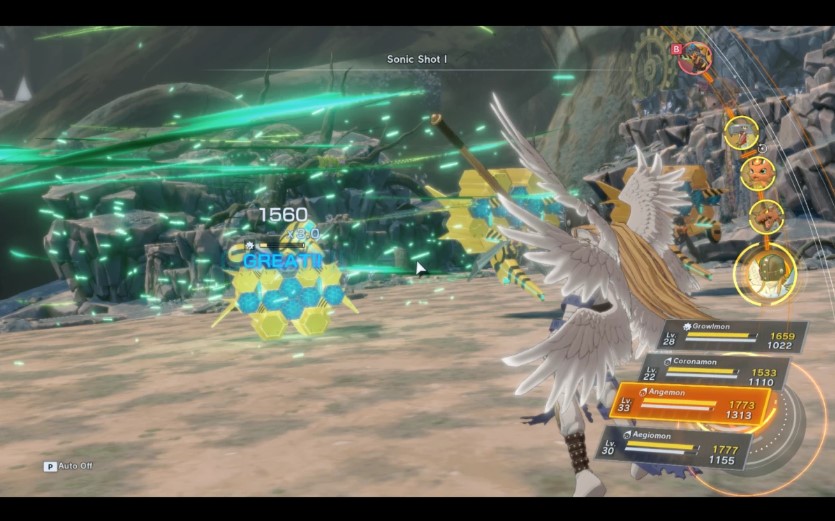
Time Stranger uses a turn-based combat system built around an action timeline that clearly shows the order of turns. Your party can include up to six Digimon three active in battle and three in reserve. Guest characters like Aegiomon occupy separate slots, functioning as controllable allies with their own HP and SP pools. Other guest allies fight automatically and can't be knocked out, often serving as convenient damage sponges during tougher fights.
Swapping reserve Digimon into battle doesn't cost a turn, as long as the new Digimon doesn't act immediately afterward. Using an item also doesn't consume a turn, though you can only use one item per round. These small details play a big role in how boss battles are structured. Most bosses make aggressive use of debuffs, status ailments, and self-buffs, pushing you to rotate your team and manage resources carefully.
Combat revolves around exploiting weaknesses across three interconnected systems: type, element, and trait. The main types Vaccine, Data, and Virus form a rock-paper-scissors relationship. Each Digimon's element adds another layer, and traits like Mineral or Avian factor into damage as well. When multiple weaknesses line up, the damage multiplier skyrockets. For example, a Virus-type Digimon attacking a Data-type Gotsumon with a Wind-based move against its Mineral trait can hit for 450 percent damage. The game's battle UI conveniently shows the math behind these interactions when you hover over abilities, meaning you never have to guess what will be effective.
Landing hits on enemy weaknesses charges Kanan's X-Arts gauge, which can activate buffs, heals, or powerful attacks depending on your setup. The system goes both ways—enemies will also exploit your team's weaknesses just as effectively. A poorly built lineup can go down from a single well-aimed attack.
Boss encounters make creative use of these mechanics. One early fight pits you against a multi-armed machine, with each arm representing a different type. Targeting and destroying specific arms with the right counters weakens the boss or prevents its ultimate attack. Later fights introduce mechanics like temporary shields that block physical or magical damage, phase shifts that alter attack patterns, and weak points that can stun bosses if destroyed mid-charge.
These battles demand real engagement. Going in with a team that's countered by the boss's elemental or type setup often leads to trial and error. The distinction between physical and magical attacks becomes crucial, especially when shields come into play. Using the guard command can help you survive heavy hits, but success ultimately comes down to smart team composition and effective swapping.
By contrast, regular encounters lack the same depth. Most standard fights can be cleared easily using auto-battle, as long as youre not at a severe type disadvantage. It's common to crank battle speed up to x5 and let the AI handle things, even on Hard mode. The tougher post-game difficulty options Mega and Mega+ ramp up enemy stats dramatically, forcing you to think strategically again, but the normal difficulties rarely require such attention outside of boss fights.
On the bright side, these simpler battles still serve a purpose. Every time you defeat a Digimon, its convert meter fills up. Reaching 100 percent lets you recruit it immediately, while waiting until 200 percent gives that Digimon better base stats and higher level caps. The grind feels manageable with auto-battle doing most of the work, but forcing players to stand still for several seconds to heal HP and SP between fights feels unnecessary. Automatic post-battle healing would have made exploration flow much more smoothly.
Signature Attacks and Attachment Skills.
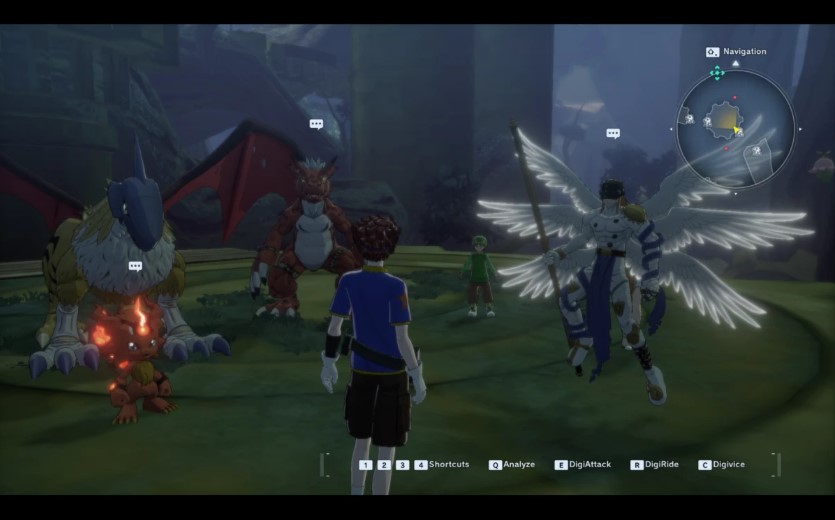
Every Digimon comes with at least one unique signature attack, while Ultimate and Mega forms usually have two or three. These moves feature distinct animations and voice lines that highlight each Digimon's personality. The English dub adds to the experience, featuring hundreds of voice actors lending battle cries and victory quotes. This level of variety brings back the nostalgic charm of older RPGs where every recruitable character or monster felt like an individual rather than a statistic.
Attachment skills work like customizable ability loadouts. Each Digimon can equip up to four of them, covering everything from elemental attacks—based on either physical or magical damage to healing abilities and stat-altering buffs or debuffs. You earn these skills through leveling or by purchasing them from shops, and they can be freely swapped between party members. This system gives you room to adapt your team for each boss battle's weaknesses without being stuck with a fixed moveset.
Many Digimon can also serve as rideable mounts, though not all are faster than moving on foot. The mounting animations vary depending on the creature: Kanan might perch on a Digimon's shoulders, ride on its head, or even sit behind them for special cases like Beelzemon's motorcycle or Witchmon's broomstick. While the lack of sound effects during these sequences is a minor omission, the feature adds both convenience and a fun sense of personality to overworld exploration.
DNA Digivolution and Temporary Fusions
Time Stranger introduces temporary DNA Digivolution attacks. In Digimon lore, specific pairs combine into entirely new forms: ExVeemon plus Stingmon becomes Paildramon. DNA Digivolutions are traditionally permanent unless De-Digivolved. Time Stranger lets players execute DNA Digivolutions as single-use attacks.
If ExVeemon and Stingmon are both active, new attack options appear labeled “DNA Digivolution.” Selecting these combines both Digimon into Paildramon for one attack animation, then separates them. This consumes both Digimons' turns and the SP cost for the attack. It is a flashy mechanic that rewards players who build parties around compatible pairs, though its tactical application is situational.
DigiFarm Training and Field Guide Completion.
The DigiFarm lets you train multiple Digimon at once through passive stat growth. Even Digimon stored there continue to earn experience points just like those in your main inventory. You can assign reusable training sets items that raise specific stats to each Digimon, with each session taking about an hour of real-world time. If you prefer, you can pay in-game currency to instantly finish a training cycle.
Once you start working toward full Field Guide completion, though, training management can feel like juggling spreadsheets. Keeping track of which Digimon needs which stat boosts to reach evolution thresholds often requires taking notes or carefully combing through menus. The fact that you can't check Digivolution requirements directly from the DigiFarm interface adds unnecessary hassle. Jumping back and forth between the DigiFarm and Digivolution menus during late-game grinding quickly becomes repetitive.
New training sets can be crafted at Zudomon's blacksmith shop for a fee, and higher-tier sets take up to ninety minutes to make unless you pay to speed them up. Interestingly, the cost to instantly finish a 90 minute training set is the same as for shorter ones, making it more efficient to save money and rush longer sessions during endgame prep.
Outer Dungeons and Minigame Variety.
Outer Dungeons introduce some welcome variety beyond the usual combat encounters. You'll occasionally find red rifts that open into timed challenges—races where you dodge obstacles, survival arenas filled with waves of Digimon, or short missions with specific objectives. Completing these events rewards you with stronger Digimon or rare crafting materials. They're quick, enjoyable detours that help break up the pace of dungeon exploration without dragging things out.
Time Stranger also features a light collectible card game. Each Digimon has its own card, giving collectors one more reason to chase the full roster. The card game and rift challenges aren't deep systems by any means, but they make for pleasant, low-pressure distractions when you need a break from combat and grinding.
Clunky Fast Travel and Antiquated Design.
Time Stranger's fast travel system perfectly captures its dedication to PS2-era design—for both good and bad reasons. There's no instant, menu-based fast travel here. Instead, once you've cleared an area, a Birdramon NPC can fly you between key landmarks within that region. To move between larger zones, you'll need to chain multiple trips together using Birdramon and Locomon, the train transport system.
For example, getting from Gear Forest Village to the Warrior's Watering Hole bar in Central Town involves talking to Birdramon in Gear Forest, selecting the Locomon station, boarding the train, choosing Central Town on the map, arriving there, finding another Birdramon, and finally choosing the bar as your destination. As the story adds more layers later on, this process only grows more elaborate. By modern standards, it's clunky and time-consuming but it's also a deliberate throwback to classic JRPGs. It feels less like an oversight and more like a nostalgic design choice that emphasizes immersion over convenience.
Presentation: Detailed Models and Environmental Polish.
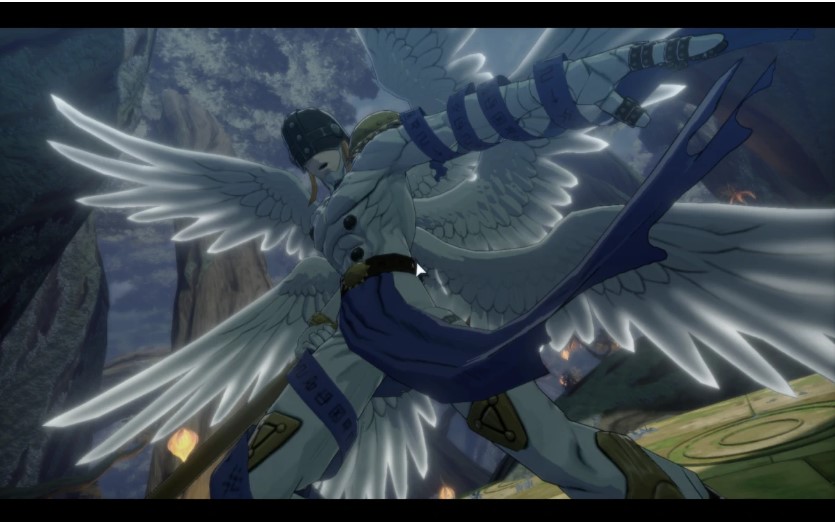
Every Digimon in Time Stranger has been completely rebuilt from the ground up. Side-by-side comparisons with Cyber Sleuth make the upgrades obvious textures are sharper, animations are smoother, and lighting blends more naturally with each model. With over 450 Digimon included, the sheer scale of the roster is impressive, especially considering each one includes custom rigging, battle animations, voice callouts, and victory poses.
The environmental design is equally cohesive. Each zone features Digimon that fit thematically with their surroundings, strengthening the sense of ecological logic within the Digital World. The world doesn't just look alive it feels alive. Digimon can be seen interacting with each other, entertaining crowds, or relaxing in the background, all of which add a sense of organic motion and community. This kind of environmental storytelling goes far beyond what previous Digimon Story titles achieved, no longer limited by the old PS Vita's hardware constraints.
What Holds It Back
The silent protagonist issue persists throughout. Kanan's lack of voice acting during story scenes creates dissonance when other characters receive full performances. Her mouth animations without audio worsen the effect, making her feel like a placeholder rather than an active participant. This choice worked in older RPGs where limited technology justified it, but in 2025 it feels like an unnecessary sacrifice for player choice (swappable protagonists).
Regular combat encounters lack challenge on standard difficulty. Auto-battle trivializes most non-boss fights, turning dungeon exploration into a series of automated skirmishes interrupted by occasional manual boss battles. Players seeking consistent challenge must wait until post-game difficulties unlock.
Fast travel and DigiFarm menu navigation slow late-game pacing. The inability to access Digivolution trees from the DigiFarm directly adds frustration during endgame Field Guide completion. These friction points accumulate over a 40 to 60-hour playthrough.
Final Thoughts
Digimon Story: Time Stranger succeeds both as a Digimon title and as a solid standalone JRPG. The Digital World of Iliad feels alive, filled with detail and purposefully placed Digimon that give each environment its own logic and flavor. With more than 450 fully rebuilt models, each infused with unique animations and personality, the game stands as both a technical and artistic milestone for the series. Combat truly shines during boss battles that test your understanding of type matchups and team composition, though regular fights often become mindless auto-battle routines. The Agent Rank and Anomaly Point systems strike a smart balance between pacing and progression, rewarding players who explore thoroughly and complete side quests.
The game fully embraces the design philosophy of the PS2 JRPG era along with its charm and frustrations. There's a nostalgic satisfaction to its structure, but that comes paired with clunky fast travel, layered menu navigation during DigiFarm management, and a silent protagonist whose stiff animations sometimes undercut emotional scenes. None of these issues ruin the experience, but they do add small bits of friction that build up over time.
For longtime Digimon fans, Time Stranger offers the most complete realization of the Digital World to date. Its deep roster, flexible evolution system, and expressive world design outclass every previous entry in the series. For general JRPG fans, it delivers a rewarding turn-based adventure built around collection, strategy, and steady, satisfying growth provided you can live with its old-school quirks. Time Stranger doesn't reinvent the genre, but it achieves its goals with confidence and heart, standing comfortably among the best Digimon games to date. If you've been longing for the spirit of a PS2-era RPG in a modern package, this is exactly that experience.
thanks for looking informatoin
.
.
.
.
.
.
Community member 😉
Prem Dharmik 🎮

Please sign in
Login and share