




























The French Footprint in India: Specifically highlights the colonial era.

1. Ancient Roots: The Roman Connection (1st Century BCE – 2nd Century CE)
Long before the Europeans arrived, the region was a bustling maritime hub. Archaeological excavations at Arikamedu (just 7 km from the modern city) revealed that Pondicherry was a major port for the Roman Empire.
- Trade: Romans traded wine, glassware, and olive oil for Indian spices, textiles (muslin), and semi-precious beads.
- Poduca: The city is mentioned as "Poduca" in the Periplus of the Erythraean Sea, an ancient Greek travelogue.
Figure 1, view larger image
2. The Era of the Great Dynasties (4th Century – 17th Century)
For centuries, the region was a prize contested by the great powers of South India:
- Pallavas & Cholas: From the 4th to the 13th century, it was a center of Sanskrit learning (known then as Vedapuri).
- Vijayanagar Empire: By the 14th century, it came under the rule of the Vijayanagar Empire, which brought stability and cultural growth.
- Sultanate of Bijapur: In the 1600s, control shifted to the Sultan of Bijapur, who eventually granted the French permission to establish a trading post.
3. The French Era: "La Ville Blanche" (1673 – 1954)
The French East India Company arrived in 1673, led by François Martin, who is considered the father of modern Pondicherry.
- Colonial Tug-of-War: For 150 years, the city was a battlefield between the French and the British. It changed hands several times, with the British even razing the city to the ground in 1761.
- Permanent French Rule: In 1814, the Treaty of Paris finally restored Pondicherry to the French for good. They built a "White Town" (French Quarter) and a "Black Town" (Indian Quarter), separated by a canal—a layout that still defines the city's aesthetics today.
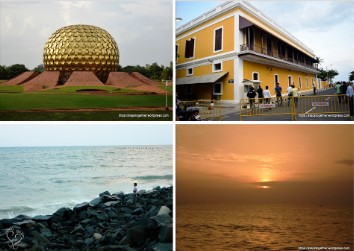
Figure 2, view larger image
4. The Spiritual Turning Point (1910)
In the early 20th century, Pondicherry became a sanctuary for Indian revolutionaries fleeing British arrest.
- Sri Aurobindo: The famous philosopher and freedom fighter arrived in 1910, seeking spiritual refuge.
- The Mother: Together with Mirra Alfassa (The Mother), he founded the Sri Aurobindo Ashram in 1926. This transformed Pondicherry from a sleepy colonial port into a global destination for seekers of "Integral Yoga."
5. Merger with India (1954)
Unlike the rest of India, which gained independence in 1947, Pondicherry remained a French territory for seven more years.
- A Peaceful Exit: After years of peaceful protests and a historic referendum in 1954 where 170 out of 178 representatives voted for a merger, the French held a de facto transfer of power on November 1, 1954.
- Dual Identity: To this day, many residents of Pondicherry hold French passports, and French remains an official language, preserving a unique "Indo-French" culture found nowhere else.

Figure 3, view larger image
Off-topic Lobby
67
8
Please sign in
Login and share
Sign in