



























Beyond the Gun: The Ideology of Bhagat Singh

Bhagat Singh (1907–1931) was an Indian socialist revolutionary whose acts of dramatic violence against the British and execution at age 23 made him a folk hero of the Indian independence movement. He is often referred to as Shaheed-e-Azam (Great Martyr).
Early Life and Influences
Bhagat Singh was born on September 28, 1907, in Banga, Punjab (now in Pakistan), into a Sikh family deeply involved in revolutionary activities against the British Raj.
- Family Background: His father and uncles were members of the Ghadar Party and active freedom fighters. This environment meant patriotism was embedded in him from childhood.
- Jallianwala Bagh Massacre (1919): At age 12, Singh visited the site of the Jallianwala Bagh massacre hours after thousands of unarmed Indians were killed by British troops. He collected the blood-soaked soil in a bottle, a moment that deeply radicalized him and disillusioned him with non-violent methods.
Revolutionary Activities
Disenchanted with Mahatma Gandhi's non-violent movement after the Chauri Chaura incident, Singh turned to revolutionary nationalism. He became a key member of the Hindustan Socialist Republican Association (HSRA).
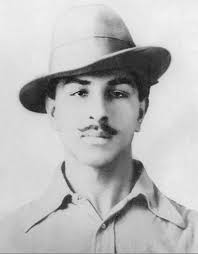
1. Avenging Lala Lajpat Rai (1928)
When the Simon Commission visited India, nationalist leader Lala Lajpat Rai was brutally beaten by the police during a protest and later died of his injuries.
- Bhagat Singh and his associates (Shivaram Rajguru, Sukhdev Thapar, and Chandrashekhar Azad) vowed revenge.
- They intended to assassinate James A. Scott, the police superintendent responsible for the order, but mistakenly killed his assistant, John P. Saunders.
- Bhagat Singh escaped Lahore to avoid arrest, famously shaving his beard and cutting his hair to disguise himself.
2. The Assembly Bombing (1929)
Rather than fleeing permanently, Singh wanted to use a trial as a platform to spread his ideology.
- On April 8, 1929, he and associate Batukeshwar Dutt threw two low-grade bombs into the Central Legislative Assembly in Delhi.
- The bombs were not designed to kill but to "make the deaf hear." They threw leaflets and shouted "Inquilab Zindabad!" (Long Live the Revolution) before voluntarily surrendering to the police.
Imprisonment and Ideology
While in prison, Bhagat Singh transformed from a violent revolutionary into a thoughtful political thinker.
- Hunger Strike: He led a 116-day hunger strike demanding equal rights for Indian political prisoners compared to British prisoners.
- Intellectualism: He was a voracious reader of Marxism, socialism, and history.
- Atheism: He wrote the famous essay "Why I Am an Atheist," in which he argued that one must rely on reason and logic rather than blind faith, even in the face of death.
Execution
Bhagat Singh, along with his comrades Rajguru and Sukhdev, was sentenced to death for the Lahore Conspiracy Case (the murder of Saunders).
They were hanged on March 23, 1931, in the Lahore Jail. It is reported that they walked to the gallows cheerfully, chanting revolutionary slogans. Their execution sparked massive outrage across India and galvanized the freedom struggle.
Legacy
Bhagat Singh remains one of the most beloved icons of modern India.
- Symbol of Youth: He represents the energy, sacrifice, and courage of the youth.
- Political Thought: Unlike many contemporaries, he looked beyond just removing the British; he envisioned a socialist India free from poverty, caste discrimination, and class exploitation.

Please sign in
Login and share