




What is Refresh Rate & Why 120Hz Matters?

Hlo, Everyone
Let’s understand refresh rate.
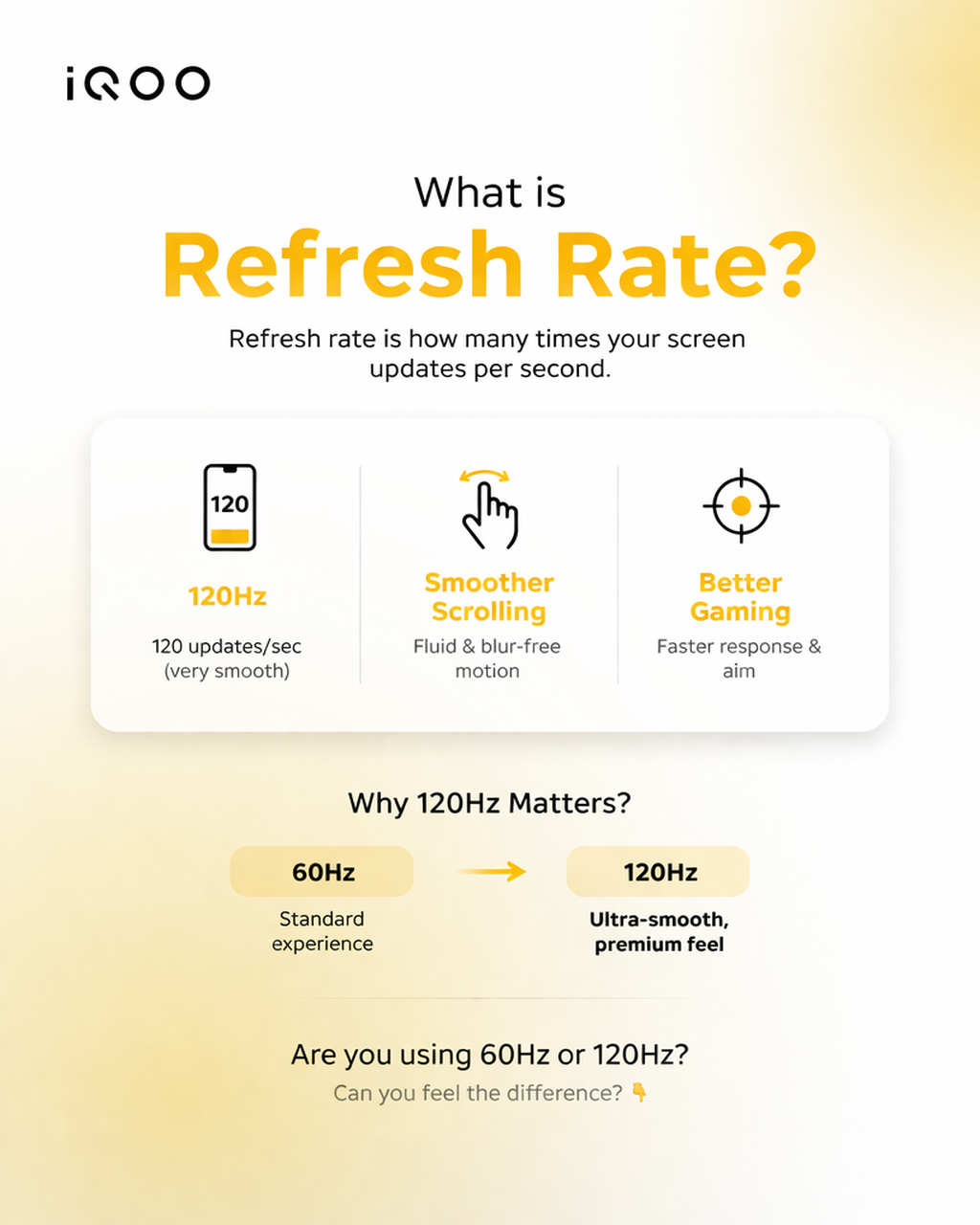
Refresh rate refers to how many times your smartphone display updates (refreshes) per second.
It is measured in Hertz (Hz)
60Hz → 60 refreshes per second
90Hz → 90 refreshes per second
120Hz → 120 refreshes per second
Think of it like flipping pages of a book: More pages per second = smoother motion
Why Higher Refresh Rate Feels Better
A higher refresh rate directly improves visual fluidity.
When you:
Scroll Instagram / Twitter
Open & close apps
Swipe through UI
At 120Hz:
Animations feel buttery smooth
Scrolling feels continuous (no stutter)
Motion blur is reduced
At 60Hz:
Slight lag/jitter visible
Not as fluid
Once your eyes get used to 120Hz, 60Hz feels slow.
Impact on Gaming Performance
For gamers, refresh rate is a big deal.
Benefits in gaming:
Faster screen updates = better reaction time
Smooth camera movement = better aim
Reduced motion blur = clear visuals
Example: In BGMI / CODM:
60Hz → Normal gameplay
120Hz → Competitive, smoother gameplay
But remember:
Game must support high FPS to fully use 120Hz.
Battery Consumption – The Trade-off
Higher refresh rate = more power usage
Why?
Because the screen is refreshing more times per second.
But iQOO optimizes this with:
Adaptive refresh rate (auto switch 60Hz–120Hz)
Smart battery management
So you get: ✔ Smoothness when needed
✔ Battery saving when not
Touch Sampling Rate
Another important factor
Touch Sampling Rate = how fast screen detects your touch
120Hz display + high touch sampling = combo
Result:
Faster response
Better gaming control
If you:
Love smooth UI
Play games regularly
Want premium experience
120Hz is absolutely worth it
But if you:
Use phone casually
Focus on battery
60Hz is still fine
@NITIN @YasirTheJOD @Swagg_rohit @JStreetS @Manab10
Thankyou
Signing Off
Please sign in
Login and share