



























Rogue Planets

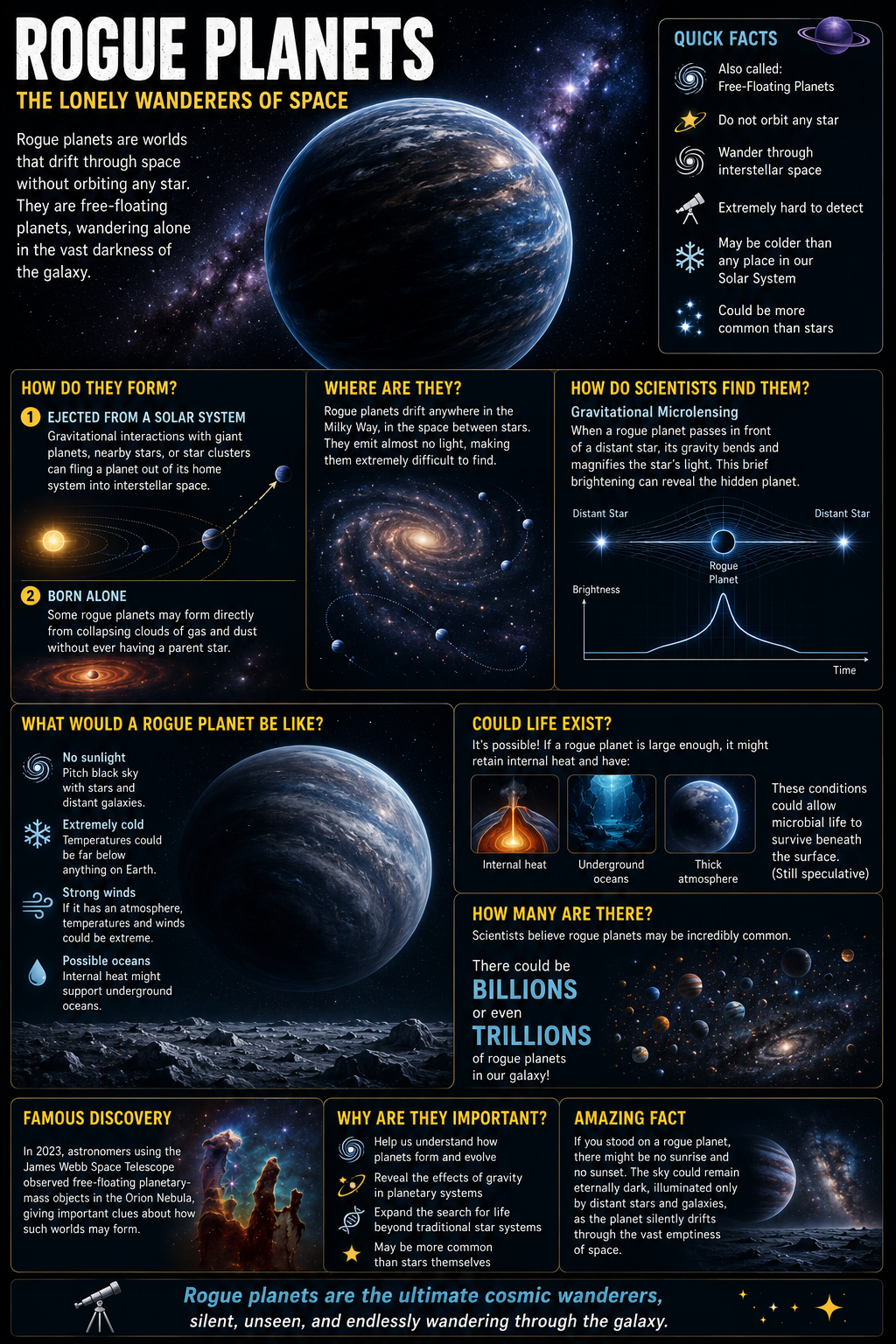
A Rogue Planet (also called a Free-Floating Planet) is a planet that travels through space without orbiting any star.
Unlike Earth, which revolves around the Sun, a rogue planet drifts alone through the darkness of interstellar space.
🌍 What Makes It Different?
Most planets are part of a solar system.
For example:
- Earth orbits the Sun
- Jupiter orbits the Sun
- Mars orbits the Sun
But a rogue planet belongs to no star system.
It wanders freely through the galaxy like a cosmic nomad.
🚀 How Do Rogue Planets Form?
1. Ejected from a Solar System
Scientists think many rogue planets originally formed around stars.
Later, gravitational interactions with:
- giant planets
- nearby stars
- stellar encounters
may have flung them into deep space.
Imagine a cosmic slingshot launching a planet away forever.
2. Born Alone
Some rogue planets may form directly from collapsing clouds of gas and dust without ever having a parent star.
In this case, they are born as lonely wanderers.
🔭 How Do Scientists Find Them?
Scientists use:
Gravitational Microlensing
When a rogue planet passes in front of a distant star, its gravity bends and magnifies the star's light.
This brief brightening can reveal the hidden planet.
This method has helped discover several candidate rogue planets.
❄️ What Would a Rogue Planet Be Like?
Most would be:
- extremely cold
- dark
- frozen
Without a nearby star, surface temperatures could plunge far below anything found on Earth.
The sky would be almost completely black.
🌋 Could Life Exist?
Surprisingly, maybe.
Some scientists think a large rogue planet could:
- retain internal heat
- have underground oceans
- possess a thick atmosphere
These conditions might allow microbial life to survive beneath the surface.
This idea remains speculative but scientifically possible.
📏 How Many Are There?
Scientists suspect rogue planets may be incredibly common.
Some estimates suggest there could be:
- billions
- or even trillions
of rogue planets in our galaxy alone.
There may actually be more rogue planets than stars.
🌠 Famous Discovery
In 2023, astronomers using observations from the James Webb Space Telescope reported free-floating planetary-mass objects in the Orion Nebula, providing important clues about how such worlds may form.
🧠 Why Are Rogue Planets Important?
They help scientists understand:
- planetary formation
- gravity
- solar system evolution
the possibility of life beyond traditional star systems
Fascinating Fact
If you stood on a rogue planet, there might be no sunrise and no sunset. The sky could remain eternally dark, illuminated only by distant stars and galaxies, as the planet silently drifts through the vast emptiness of space. 🌌🪐✨
Please sign in
Login and share