




















🔬💡 30 June 1948 : The Tiny Invention That Powered the Digital World

Hi Questers 🤗 ✨
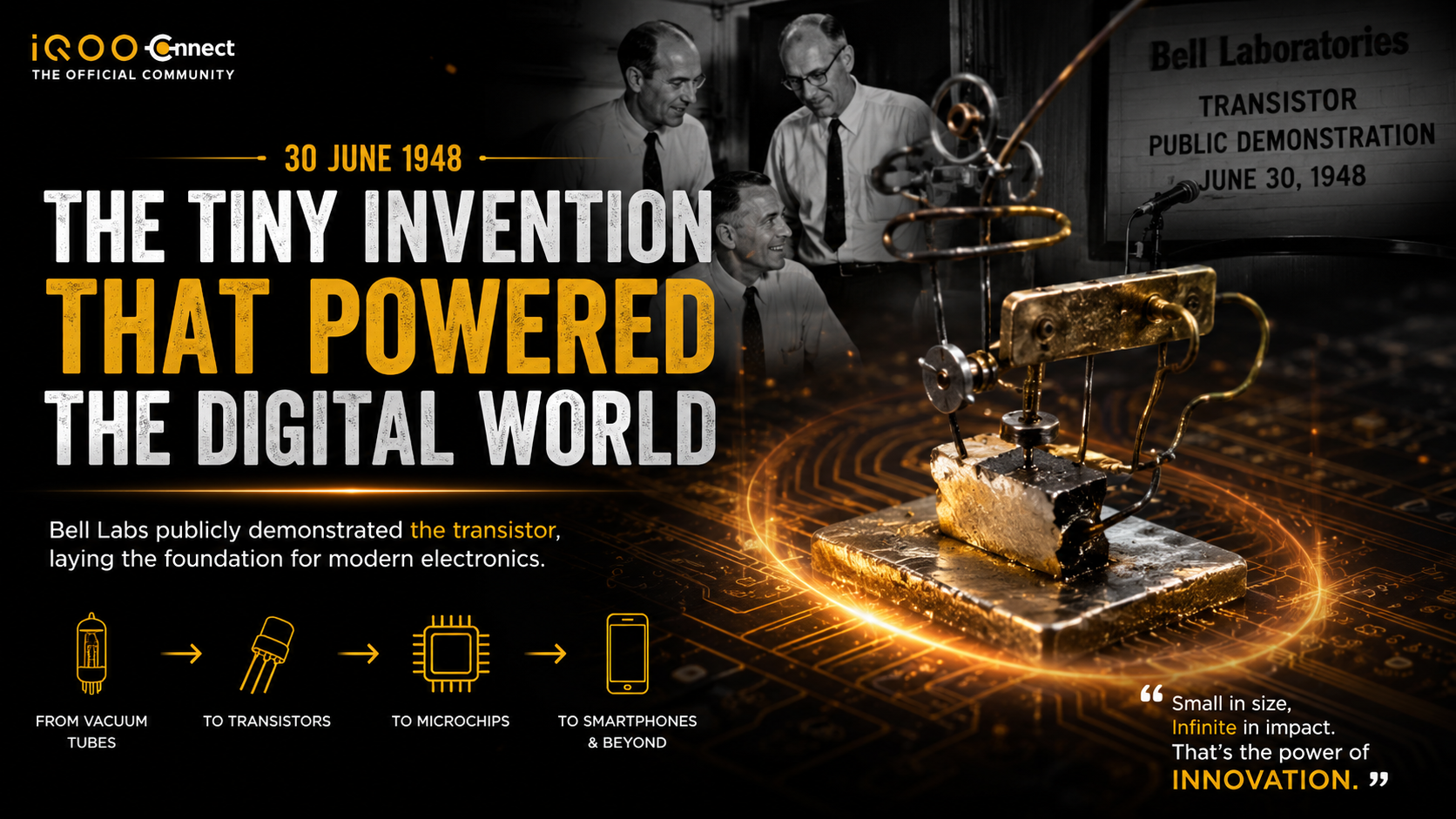
On 30 June 1948, scientists at Bell Laboratories publicly demonstrated one of the most revolutionary inventions in human history - the transistor.
Although small enough to fit on a fingertip, the transistor became the foundation of modern electronics, making today's smartphones, computers, satellites, AI systems, and countless other technologies possible.
⚡ What is a Transistor?
A transistor is a tiny semiconductor device that can :
- Amplify electrical signals
- Act as an electronic switch
- Control the flow of electricity with incredible precision
Think of it as the fundamental building block of every modern electronic device.
Without transistors, the digital age simply wouldn't exist.
Why Was It Revolutionary?
Before transistors, electronic devices relied on vacuum tubes, which were :
- Large and bulky
- Fragile and prone to failure
- Generated excessive heat
- Consumed significant power
The transistor changed everything.
It was :
- Much smaller
- Faster and more reliable
- Highly energy-efficient
- Easier to manufacture in large quantities
This breakthrough paved the way for compact, affordable, and powerful electronic devices.
From One Transistor to Billions
The first transistor was relatively simple, but continuous innovation transformed the electronics industry.
Today, a single flagship smartphone processor can contain tens of billions of transistors, all working together to perform billions of calculations every second.
These microscopic components power everything from photography and gaming to AI, cloud computing, and advanced mobile experiences.
📱 How Transistors Shape Our Daily Lives
Nearly every piece of modern technology depends on transistors :
- 📱 Smartphones
- 💻 Laptops and PCs
- 🎮 Gaming consoles
- 🚗 Smart vehicles
- 🛰️ Satellites and space technology
- 🤖 Artificial Intelligence systems
- ⌚ Smartwatches and wearables
Every tap, swipe, photo, game, and app relies on billions of transistors working seamlessly behind the scenes.
💡 The Heart of Modern Smartphones
For smartphone enthusiasts, transistors are the reason mobile technology continues to evolve.
Every new chipset generation delivers :
- Faster performance
- Better battery efficiency
- Smoother gaming
- Smarter computational photography
- More powerful on-device AI
As transistor technology advances, smartphones become faster, more efficient, and capable of features that once seemed impossible.
🌍 Did You Know?
- The transistor was invented in 1947, but its first public demonstration took place on 30 June 1948 at Bell Laboratories.
- The invention earned John Bardeen, Walter Brattain, and William Shockley the Nobel Prize in Physics in 1956.
- Modern processors are manufactured using processes measured in nanometres (nm), allowing billions of transistors to fit onto a chip no larger than a fingernail.
✨ A Tiny Invention with an Infinite Impact
The public demonstration of the transistor on 30 June 1948 marked the beginning of a technological revolution that transformed communication, computing,
medicine, transportation, entertainment, and scientific research.
Every modern smart device carries the legacy of this remarkable invention.
Sometimes, the smallest innovations create the biggest changes. 🌍📱⚡
Do follow me 😊 👉 @Harish12
Stay curious😸✨..Stay iQOO💪💥..
Signing off until next time 😸 👋
Please sign in
Login and share